GPS Jammer: How It Works, Types, Legality, and Detection
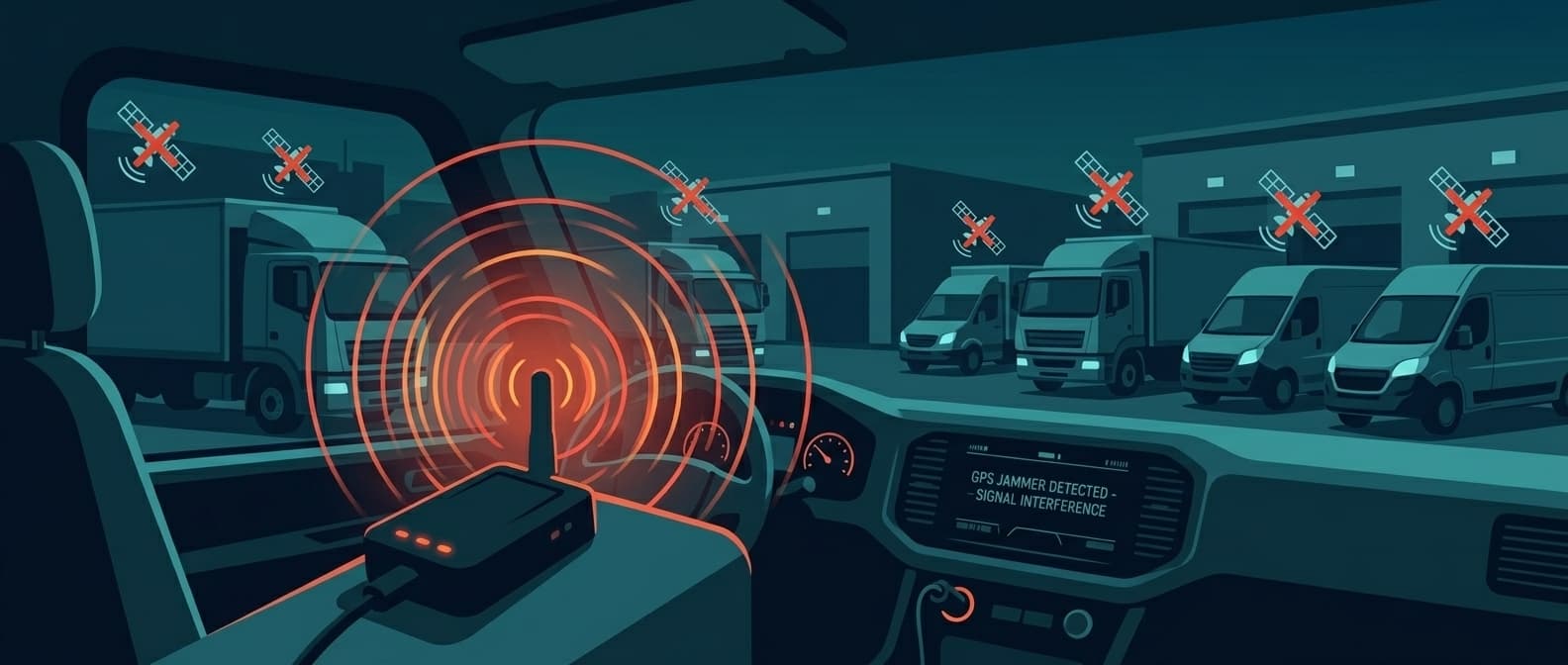
A GPS jammer (also sold as a GPS blocker or GPS signal blocker) is a $25-$50 plug-in device that broadcasts noise on the GPS L1 band at 1575.42 MHz, creating a 10-50 meter dead zone that hides a vehicle from Samsara, Geotab, and every GPS tracker. It is illegal to operate in the US under 47 USC 333. It cannot block Bluetooth Find My tracking, which runs on an entirely different 2.4 GHz signal.
A GPS jammer costs $25-$50. It plugs into a cigarette lighter. It creates a 10-50 meter radio dead zone. And it completely defeats Samsara, Geotab, Verizon Connect, and every other GPS-based fleet tracking system on the market.
Fleets in North America and Europe find jammers in company vehicles every year, usually after a driver's position trail shows the same gaps at the same times. Every major GPS fleet platform shares this exposure because they all depend on the same satellite signal at 1575.42 MHz.
What Is a GPS Jammer?
A GPS jammer is a small radio transmitter that broadcasts noise on the frequencies GPS satellites use, mainly L1 at 1575.42 MHz. Satellite signals arrive at the ground extremely weak, so even a low-power jammer drowns them out within a short radius and any GPS receiver nearby stops getting a position fix. Most consumer units plug into a 12V outlet in a car or truck.
Are GPS Blockers and GPS Jammers the Same Thing?
Yes. "GPS blocker," "GPS signal blocker," and "GPS jammer" all name the same hardware: a small transmitter that floods the GPS frequency with noise so a nearby receiver cannot compute a position. Retailers label them "blockers" or "anti-tracking devices" to sound harmless, but the FCC classifies all of them as jammers, and all are illegal to operate in the United States. A "GPS blocker for cars" is simply a 12V unit sized to plug into a cigarette lighter. None of them touch Bluetooth, so a Find My tracker keeps reporting through the jammed zone.
How GPS Jammers Work
GPS satellites orbit 20,200 km above Earth. By the time their signals reach a receiver on the ground, the power level is incredibly weak: roughly -130 dBm, about one ten-billionth of a billionth of a watt. This is what makes GPS precise and also what makes it fragile.
A GPS jammer broadcasts noise on the same frequencies. The primary target is the L1 band at 1575.42 MHz. More expensive jammers also hit the L2 band at 1227.60 MHz. The jammer doesn't need much power. Even 10 milliwatts of interference at close range is enough to drown out a satellite signal that traveled 20,000 km.
The result: every GPS receiver within 10-50 meters (depending on jammer power) loses its position fix. The tracker shows "no signal" or freezes at the last known location. Some units continue reporting old coordinates, making it look like the vehicle is parked when it's actually moving.
The devices themselves are simple. A typical unit is a small plastic box, 60mm x 45mm x 20mm, with a 12V power plug and one or two short antennas. You plug it in, and it starts jamming. No configuration, no software, no technical knowledge required.
Types of GPS Jammers: Portable, Cigarette-Lighter, Hard-Wired Multi-Band, and Chirp
Four types exist, and the cheap 12V plug-in is the one fleets most often encounter. Their power source and band coverage differ, but each type interferes with GPS reception rather than changing the satellite data.
| Type | How it is powered | Typical range | Bands blocked | What it still cannot block |
|---|---|---|---|---|
| Portable battery unit | Internal battery | A few meters | GPS L1 | Bluetooth 2.4 GHz, cellular |
| Cigarette-lighter plug-in | Vehicle 12V socket | 10-50 meters | GPS L1, sometimes L2 | Bluetooth 2.4 GHz, cellular |
| Hard-wired multi-band | Wired to vehicle power | Tens of meters | GPS L1/L2 plus cellular and Wi-Fi bands | Bluetooth Find My relays outside the jammed radius |
| Chirp jammer | 12V or battery | Varies | GPS L1, swept across the band instead of flat noise | Bluetooth 2.4 GHz |
What Does a GPS Jammer Look Like?
The jammer fleets find most often looks like a phone charger. It is a plug that fits the 12V cigarette-lighter socket, usually with an LED and one to three short antenna stubs on the end. Portable units range from the size of a deck of cards to a small handheld radio, and multi-band models carry a row of fold-out antennas, one per band. Hard-wired units sit behind the dash or under a seat, spliced into vehicle power, with no visible antenna at all. When a driver's truck shows GPS gaps that start and stop with the ignition, check the 12V socket first.
How Much Does a GPS Jammer Cost?
A plug-in GPS jammer sells for roughly $25 to $50 on overseas marketplaces, the price range quoted throughout this guide. Battery and multi-band handheld units cost more because they add batteries and extra transmitter stages. There is no legitimate retail price in the US: the FCC bans marketing, selling, and using these devices, so every listing an employee finds is an import that can be seized at the border.
GPS Jamming vs GPS Spoofing
Jamming drowns the signal so the receiver reports no fix or freezes; spoofing broadcasts fake satellite signals so the receiver computes a wrong position and keeps reporting confidently. Both are illegal to transmit in the US under 47 USC 333, and neither touches a Bluetooth tag's 2.4 GHz broadcast. Spoofing detection works differently from jamming detection; see how to detect fake GPS and spoofing in a fleet.
Why Employees Use Them
The assumption is that jammers are used by criminals and cargo thieves. Some are. But the primary market for GPS jammers is employees driving company vehicles.
Personal errands during work hours. A driver takes a 45-minute detour to pick up groceries, drop off a kid at school, or grab lunch outside their assigned zone. The jammer runs for the side trip, then gets unplugged. The tracking log shows a signal gap.
Side jobs. Delivery drivers, service technicians, and contractors use company vehicles for side gigs. A plumber who does freelance jobs on company time doesn't want his route history showing three stops at residential addresses that aren't on the schedule.
Privacy objections. Some drivers simply resent being monitored. They view constant GPS tracking as surveillance. The jammer is a $30 act of protest.
Moonlighting with company assets. Construction workers using fleet vehicles to run personal jobs on weekends. The jammer hides the mileage and locations.
Covering up policy violations. Speeding, excessive idling, unauthorized stops, driving outside geofence boundaries. All of these trigger alerts in fleet management systems. A jammer makes them invisible.
None of these are sympathetic use cases from a fleet manager's perspective. But they explain why the demand for jammers is so high and why they keep showing up in commercial fleets.
How Prevalent Is This?
There is no reliable public count of jammers in US commercial vehicles, because operating one is illegal and drivers do not report it. What is on the public record is the enforcement side.
| Case | Year | Agency | Outcome |
|---|---|---|---|
| New Jersey driver whose truck jammer disrupted the GPS landing aid at Newark Liberty Airport | 2013 | FCC and FAA | $31,875 fine |
| C.T.S. Technology, a Chinese online seller of GPS and cell jammers to US buyers | 2014 | FCC | $34.9 million proposed forfeiture |
Jammers are still listed openly on overseas marketplaces under names like "GPS signal blocker" and "anti-tracking device," and marketplace takedowns tend to be followed by new listings. For a fleet manager, the practical takeaway is to treat jamming as a known risk and watch the data for the patterns in the next section.
How to Detect GPS Jamming
Jamming leaves fingerprints if you know where to look.
Sudden, complete signal loss. GPS trackers occasionally lose signal in parking garages, dense urban canyons, or heavily wooded areas. But a jammer creates a sharp cutoff: full signal, then nothing. Natural signal loss is gradual. Jammer-induced loss is a cliff.
Signal loss that correlates with specific drivers. If vehicle #47 loses GPS signal every Tuesday afternoon but works fine the rest of the week, that's not a hardware problem. Cross-reference signal gaps with driver schedules.
"Impossible" routes. The vehicle's last known position is at a job site. The next position fix, 90 minutes later, is 80 miles away. The gap implies travel that wasn't recorded. Some fleet systems flag these as GPS anomalies. Most don't.
Consistent signal loss at shift boundaries. Signal drops at the start of a shift and returns at the end. This pattern almost always indicates deliberate interference.
Elevated noise floor on L1 frequency. More sophisticated fleet trackers can report signal-to-noise ratios. A jammer raises the noise floor on GPS frequencies even when it doesn't completely kill the signal. A baseline of C/N0 values (carrier-to-noise density) dropping from 40+ dB-Hz to below 25 dB-Hz is a strong indicator.
| Detection Method | Difficulty | Reliability | What It Catches |
|---|---|---|---|
| Signal gap analysis | Low | Medium | All jammers |
| Driver correlation | Low | High | Repeat offenders |
| Route impossibility checks | Medium | Medium | Longer jamming sessions |
| C/N0 monitoring | High | High | Even weak jammers |
| RF detection hardware | High | Very high | Active jamming in real time |
Some companies have deployed dedicated jammer detection devices (like Chronos Technology's CTL3520) in their fleets. These units monitor GPS frequencies for interference signatures and can alert dispatchers in real time. But at $500-$1,000 per vehicle, the cost adds up quickly.
GPS Jammer Detectors: Hardware That Spots Jamming in Real Time
A GPS jammer detector is a receiver that monitors the GPS L1 band and alerts when the noise floor rises above normal. It answers a different question than a GPS tracker detector, which looks for a tracker's cellular transmissions. If you suspect a driver is running a blocker, a jammer detector is the right tool.
| Detector type | Where it sits | What it tells you | Example |
|---|---|---|---|
| Handheld jammer detector | Carried by a manager or security team | Whether a jammer is active nearby, with signal strength to walk toward it | Chronos CTL3520 |
| Fixed or portable monitoring probe | Yard gate, depot, or mounted in a vehicle | Logged interference events with timestamps for later review | GPSPatron GP-Probe |
| Tracker-side C/N0 reporting | Inside the fleet tracker itself | Signal quality per position fix, so drops show up in the dashboard | Depends on the tracker's firmware |
A yard gate probe is the cheapest way to catch a repeat offender: a jammer left plugged in will trip it every time that vehicle enters or leaves.
The Legal Situation
GPS jammers are illegal in the United States under the Communications Act of 1934, specifically 47 USC Section 333, which prohibits willful interference with licensed radio communications. GPS signals are operated by the U.S. Air Force and licensed through the Department of Defense.
The penalties are serious on paper:
- Civil fines: Up to $112,500 per violation per day
- Criminal penalties: Up to $100,000 in fines and one year imprisonment
- Equipment seizure: The FCC can confiscate all jamming equipment
The FCC's most publicized enforcement case involved a New Jersey man who used a GPS jammer in his company truck from 2010 to 2013. His jammer interfered with the Newark Liberty International Airport's GPS-based aircraft landing system. He was fined $31,875 after the FAA and FCC tracked the interference source to his vehicle.
But this case was exceptional because it involved aviation safety. For ordinary fleet use, enforcement is functionally nonexistent. The FCC does not have the resources to investigate individual jammer use in commercial vehicles. Local law enforcement generally doesn't know how to detect jammers and has no mandate to look for them.
Outside the US the rules point the same way. Canada prohibits the manufacture, import, sale, and use of jammers under the Radiocommunication Act. In the UK, Ofcom regulations made it a criminal offence to sell, advertise, or possess a jammer for use, on top of the Wireless Telegraphy Act 2006 ban on using one. Across the EU a GPS jammer cannot legally be placed on the market, because it cannot meet the Radio Equipment Directive.
This creates a strange legal environment. The devices are clearly illegal to use. They are trivially easy to buy. And there is almost zero enforcement risk for the average user. Fleet managers who discover jammer use by employees are essentially on their own in terms of remediation.
How to Report GPS Jamming
In the US, report suspected jamming to the FCC through its consumer complaint center at fcc.gov/complaints, or to the FCC Enforcement Bureau when the interference is ongoing. Civil users can also report GPS outages and interference through the "Report a GPS Problem" page on gps.gov, which routes reports to the U.S. Coast Guard Navigation Center.
Inside a fleet, treat a found jammer as evidence. Photograph it in place, note the vehicle, driver, date, and the GPS gaps in your tracking history that match it, then remove it with the vehicle off. Bring HR or legal in before confronting the driver, because a jammer finding usually becomes a disciplinary or termination record.
The Fundamental Vulnerability
This is the core problem that GPS-based fleet tracking vendors don't address in their sales presentations.
A company spends $15,000-$50,000 per year on fleet tracking. The hardware is bolted to vehicles. The software runs on servers. The contracts are multi-year. The entire investment depends on one thing: uninterrupted GPS satellite signals at 1575.42 MHz.
A $30 device from AliExpress defeats all of it.
This isn't a bug that can be patched. It's a physics problem. GPS signals are weak because they travel from orbit. Jammers are strong because they're sitting inside the vehicle. No amount of firmware updates, antenna improvements, or anti-tampering features changes this equation.
Some fleet tracking vendors have added "tamper alerts" that trigger when the GPS signal is lost. This is better than nothing, but it has two problems. First, the alert itself confirms that the jammer is working. The vehicle is no longer being tracked. Second, tamper alerts generate so many false positives (tunnels, parking garages, urban canyons) that dispatchers learn to ignore them.
Anti-jam GPS technology exists in military applications. It uses techniques like controlled reception pattern antennas (CRPA) and spread-spectrum processing. But military anti-jam systems cost $10,000-$100,000 per unit. They are not viable for commercial fleet tracking.
Why Bluetooth Mesh Tracking Is Different
Apple's Find My network operates on a completely different set of principles than GPS tracking. Understanding the difference explains why it's inherently resistant to GPS jammers.
Different frequencies. Find My uses Bluetooth Low Energy (BLE) at 2.4 GHz. GPS operates at 1.575 GHz (L1) and 1.227 GHz (L2). A GPS jammer targets GPS frequencies specifically. It does not broadcast on 2.4 GHz. A device jamming GPS has zero effect on Bluetooth signals.
Different infrastructure. GPS depends on 31 satellites orbiting at 20,200 km altitude. Find My depends on over 1 billion active Apple devices: iPhones, iPads, Macs, Apple Watches. These devices are everywhere. On highways, in parking lots, at job sites, in neighborhoods. When a Find My tracker broadcasts its BLE signal, any nearby Apple device picks it up and relays the encrypted location to Apple's servers.
Different attack surface. To jam GPS, you need one device broadcasting on one frequency band. To block Find My, you would need to jam the 2.4 GHz band across a wide area. But 2.4 GHz is shared with Wi-Fi, Bluetooth keyboards, wireless mice, baby monitors, microwave ovens, and hundreds of other devices. Jamming 2.4 GHz in a meaningful area would disrupt all wireless communication for everyone nearby, which is immediately noticeable and dramatically more difficult than a targeted GPS jammer.
Different detection model. GPS is one-to-one: one vehicle receiver listening to satellites. Find My is many-to-one: potentially dozens of Apple devices within range of a single tracker at any time. Even if you could block one nearby iPhone from receiving the BLE signal, there are others. The mesh network is inherently redundant.
| Factor | GPS Tracking | Find My (BLE) Tracking |
|---|---|---|
| Signal frequency | 1.575 GHz (L1) | 2.4 GHz (BLE) |
| Signal source | 31 satellites, 20,200 km away | 1B+ Apple devices, 0-100m away |
| Signal strength at receiver | -130 dBm (extremely weak) | -60 to -90 dBm (strong) |
| Jammer cost | $25-$50 | Would require wideband 2.4 GHz jammer ($500+, disrupts all Wi-Fi) |
| Jammer effectiveness | Complete GPS blackout in 10-50m | Would need to block every Apple device in range |
| Power requirement | Engine on (most trackers) | CR2032 coin cell, 12+ months at full update rate |
| Update frequency | Every 30s-5min (wired); ~1/day on battery (to hit "3-year" battery claims) | Every 1-5 min in populated areas |
| Coverage gaps | Tunnels, garages, urban canyons | Minimal in any populated area |
One more detail on battery-powered GPS trackers for unpowered assets: their advertised battery life assumes roughly one update per day. Tracki's own published spec makes this plain: 2-3 days of battery in real-time mode (updates every 1-5 minutes), 30-75 days at 1-3 updates per day. A "3-year" battery tag like the Samsara AG46 battery option holds about 1,100 total location updates at that pace. An AirTag running through Apple's billion-device network delivers that many updates in under three days and keeps going for 12+ months. The jamming vulnerability is one reason to add BLE tracking. The update-rate math is another. Battery-powered GPS on an unpowered asset gives you either a long battery or a useful update rate. Never both.
The Hybrid Approach
The smart move for fleet managers is not to replace GPS tracking. GPS provides real-time speed, heading, and precise coordinates that BLE tracking can't match. The smart move is to add a jammer-proof backup layer.
A Find My compatible tracker attached to each vehicle provides a second, independent tracking path. During normal operations, the GPS tracker handles real-time monitoring, route optimization, and speed alerts. If the GPS signal disappears, whether from a jammer, a malfunction, or a coverage gap, the BLE tracker continues reporting locations through Apple's network.
This creates a detection mechanism that is far more powerful than signal-loss alerts. If the GPS tracker goes dark but the BLE tracker keeps reporting, you know the vehicle is still moving. You know roughly where it is. And you know the GPS blackout is deliberate.
Cost comparison:
| Approach | Per-Vehicle Cost | Jammer Resistant? | Real-Time Speed/Heading? | Battery notes |
|---|---|---|---|---|
| GPS-only (Samsara, Geotab) | $25-$60/month | No | Yes | Wired = fine; battery asset tags hit "3yr" by updating ~1/day (~1,100 total updates) |
| BLE-only (AirTag/Find My) | $11.99/month (Airpinpoint) | Yes | No | CR2032, 12+ months at full rate (~100,000+ updates) |
| Hybrid (GPS + BLE) | $30-$75/month | Yes | Yes | GPS handles wired vehicles; AirTag handles unpowered assets |
The incremental cost of adding BLE tracking to an existing GPS fleet is minimal. An AirTag costs $29 one time. A managed platform like Airpinpoint runs $5-$15/month per asset and provides a dashboard, geofence alerts, and location history across your entire fleet.
What Fleet Managers Should Do Right Now
1. Audit your signal gap data. Pull the last 90 days of GPS data for your fleet. Look for vehicles with disproportionate signal loss. Correlate gaps with specific drivers and time patterns. You probably already have the data; you just haven't looked at it through this lens.
2. Establish a jammer use policy. Make it explicit in your employee handbook that GPS jammer use in company vehicles is a federal crime and grounds for termination. Most companies have GPS tracking policies but don't specifically address jamming.
3. Deploy BLE tracking as a backup layer. Attach a Find My compatible tracker to each vehicle in addition to your existing GPS tracker. This gives you a jammer-proof fallback and an instant detection mechanism when GPS and BLE data diverge.
4. Consider RF detection for high-value fleets. If you run vehicles carrying high-value cargo, dedicated jammer detection hardware ($500-$1,000/vehicle) may be justified. For most fleets, the BLE backup approach is more cost-effective.
5. Review your fleet tracking contract. Ask your GPS tracking vendor what happens when a vehicle's GPS signal is jammed. What data do you get? What alerts fire? How do they differentiate jamming from natural signal loss? The answers will tell you a lot about how seriously they take this problem.
GPS Jammer FAQ
Do GPS jammers work?
Yes, within their radius. A 12V plug-in GPS jammer overpowers the weak satellite signal for roughly 10 to 50 meters, so any GPS tracker in the same vehicle loses its fix and either freezes on the last position or reports no location. They do not change the satellite signals themselves, and they stop working the moment they are unplugged.
Are GPS blockers illegal to have in your car?
In the US, using one is illegal under 47 USC 333, and the FCC also bans selling and marketing them. A driver caught using one faces fines and seizure of the device. Canada and the UK go further and restrict possession for use as well.
What is the range of a GPS jammer?
Cheap cigarette-lighter units cover about 10 to 50 meters. Handheld battery units often cover only a few meters. Higher-power illegal units can reach farther, which is how a single truck jammer near Newark disrupted an airport landing system.
Can a GPS jammer block an AirTag?
A GPS-only jammer cannot, because an AirTag has no GPS receiver and broadcasts over Bluetooth at 2.4 GHz. A multi-band jammer that also floods the 2.4 GHz band can drown nearby Bluetooth relays inside its radius, but the AirTag reports again as soon as an iPhone outside that radius hears it or the jammer is switched off.
What is a GPS jammer detector?
A GPS jammer detector is a receiver that watches the GPS L1 band and alarms when the noise floor jumps, which is the signature of a jammer nearby. Fleet versions sit in a depot or gate and log the time and strength of each event. Some telematics units also flag sudden loss of fix with full cellular signal as a likely jamming event.
What GPS Jamming Means for Your Fleet Tracking
The fleet tracking industry has built a $30+ billion market on a technology with a known, exploitable, and cheap-to-exploit vulnerability. GPS jammers are illegal, readily available, and practically unenforced. Every year, GPS tracking gets more sophisticated with better dashboards, better integrations, better analytics. And every year, the same $30 device defeats all of it.
This doesn't mean GPS tracking is useless. It means GPS tracking alone is insufficient. Any fleet tracking strategy that depends on a single signal type has a single point of failure.
Bluetooth mesh networks like Apple's Find My work as a redundancy layer next to GPS. They track through a fundamentally different mechanism that GPS jammers cannot affect. Adding them to your fleet costs less per month than the signal gap from a single jammed trip.
At $30 and a few clicks on an overseas marketplace, assume some drivers know about GPS jammers, and plan your tracking so one blocked signal does not blank out a vehicle.
Airpinpoint provides jammer-resistant fleet tracking through Apple's Find My network. One dashboard for every vehicle, every asset, with geofence alerts and full location history. Works alongside your existing GPS system or standalone. Setup takes 5 minutes per vehicle.
Apple stops at 32 AirTags per account
Airpinpoint tracks unlimited tags in one dashboard, with location updates about every 5 minutes, geofence alerts, and a REST API, from $11.99 per tag per month.
Free to start. Works with the AirTags you already own. 6,700+ tags under management.
