
AirTags vs Asset Panda: The Hidden $3,000/Year Minimum (2026 Comparison)
The core problem with Asset Panda is that you cannot find out what it costs. The official pricing page is a quote-request form. Behind that form, contract data from Vendr (43 real purchases) shows a median price of $3,506 per year, with deals ranging from $1,848 to $10,345. The entry plan starts at $3,000 per year with a 5-user minimum, billed annually with no monthly option, and per the Terms of Use, "fees paid are non-refundable."
There is a second problem: Asset Panda is a barcode platform, not a tracking platform. It records the GPS position of the phone at the moment someone scans a tag. Between scans, it has no idea where anything is.
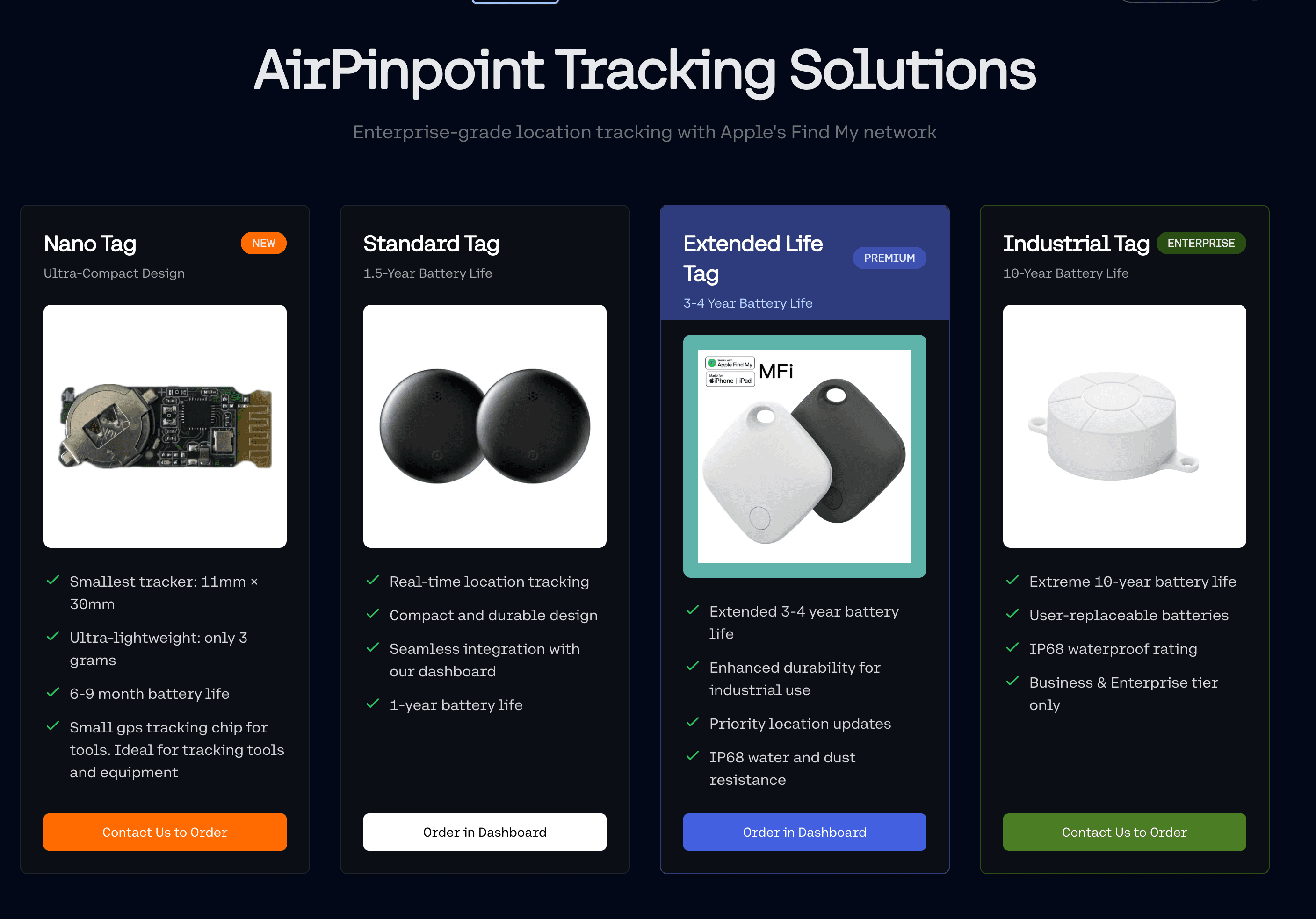
Airpinpoint takes the opposite approach: a $29 beacon (or $24.75 each in 4-packs) attached to the asset, tracked passively through Apple's Find My network of 1B+ devices, at $11.99/device/month with no contract. No scanning, no quote call, no annual prepay.
Asset Panda Actual Pricing: What Customers Report Paying
Asset Panda quotes every deal individually. These are the numbers buyers and pricing researchers report:
| What | Reported price | Source |
|---|---|---|
| Median real contract (43 purchases) | $3,506/year | Vendr |
| Real contract range | $1,848 to $10,345/year | Vendr |
| Starter tier (5 users, up to 1,000 assets) | $3,000/year | Desk365 pricing research, May 2026 |
| Business+ tier (10 users, up to 5,000 assets) | $7,500/year | Desk365 |
| Enterprise tier (20 users, up to 10,000 assets) | $18,000/year | Desk365 |
| Per-seat rates (Contributor / Admin / Enterprise) | $600 / $720 / $900 per user/year | CheckThat.ai |
| Data migration | $1,000-$5,000 (custom quoted) | CheckThat.ai |
| Custom integrations | $5,000-$25,000+ | CheckThat.ai |
| Scanners, label printers, tags | $330-$875 (small) to $3,280-$10,300 (large) | CheckThat.ai |
The contract mechanics matter as much as the sticker:
- Annual prepay only. There is no month-to-month option. You commit to 12 months up front.
- Non-refundable. The Terms of Use state "fees paid are non-refundable" and "any optional services you order are non-cancellable, and the applicable fees are non-refundable."
- Prices can change. The same terms reserve the right to "establish, remove and/or revise the Charges... at any time in Provider's sole discretion," and third-party cost increases pass through "effective immediately."
Airpinpoint's pricing is public: $11.99/device/month (Business) or $14.99 (Enterprise), $29 per beacon one-time, no contract, cancel any month.
Head-to-Head Comparison
| Feature | Asset Panda | Airpinpoint |
|---|---|---|
| How it tracks | Manual barcode/QR scan | Passive Bluetooth (Find My network) |
| Real-time location | No (scan-time phone GPS only) | Yes (continuous via 1B+ Apple devices) |
| Human action required | Yes, every time | No |
| Published pricing | No (quote form only) | Yes ($11.99/device/month) |
| Entry price | $3,000/year, 5-user minimum | $11.99/month for 1 device |
| Contract | 12-month prepay, non-refundable | None, month-to-month |
| Pricing model | User seats + asset volume | Per device |
| Geofencing | No | Yes (polygon geofences) |
| After-hours movement alerts | No | Yes |
| Location history | Scan history only | Continuous location trail |
| Depreciation tracking | Yes | No |
| Maintenance scheduling | Yes | No |
| Check-in/check-out | Yes (barcode scan) | No (location is automatic) |
| Offline mobile mode | Yes (added in Pro, Sept 2025) | Web dashboard |
| API / webhooks | API | REST API + webhooks |
| Audit trail | Yes (scan-based, who/when/where) | Yes (location-based) |
The Compliance Problem
Barcode tracking has a dependency no software can fix: people.
Asset Panda records the GPS coordinates of the phone at scan time. Between scans, the system has zero visibility. If a generator moves from Site A to Site B on Tuesday and nobody scans it until Friday, Asset Panda shows it at Site A for three days. Independent comparisons confirm there is no live tracking, no trip history, and no geofencing; GPS is logged only at the moment of scan.
This is not an Asset Panda bug. It is how every scan-based system works. The data is only as good as the scan compliance rate, and field crews towing a trailer at 6 AM do not stop to scan barcodes. For IT assets with a structured check-out desk, compliance is high. For field equipment, it is not.
Airpinpoint removes the human from the loop. Beacons broadcast to Apple's Find My network, and any of 1B+ nearby Apple devices relays the location automatically.
What Reviewers Say About Asset Panda
The rating spread is unusual. Asset Panda scores 4.6/5 on Capterra across 1,363 reviews but only 3.9/5 on G2 across 41 reviews, with 4.3/5 on Gartner Peer Insights.
Recurring complaint patterns across G2, Capterra, and Software Advice:
- Mobile app speed and sync. Reviewers describe the app as slow with occasional syncing failures, which undermines quick field updates.
- Report delivery. Reports are delivered by email rather than downloaded directly, which reviewers say slows audits. There is no straightforward bulk data export outside of generated reports.
- Tedious data entry. Entering assets is described as slow, and Active Directory sync issues complicate user management.
- Reporting depth. Reporting is flexible but lacks the advanced analytics and visual tools of competitors, and users report difficulty pulling accurate historical reports.
The consistent bright spot: customer support. Reviewers across platforms report fast, helpful responses, often within hours.
Where Asset Panda Genuinely Wins
Asset Panda is a strong product for asset management (the records about assets), as opposed to asset tracking (where assets physically are).
IT Asset Management
Laptops, monitors, servers, office equipment moving through structured check-out workflows. Someone scans, signs, and the system logs the transaction. This is Asset Panda's core use case and it does it well.
Financial Asset Tracking
Depreciation schedules, purchase costs, warranty expirations, insurance values. If your CFO needs depreciation reports tied to physical assets, Asset Panda delivers and Airpinpoint does not.
Maintenance Scheduling
Service intervals, repair tickets, maintenance history, alerts when an asset is due for service. Airpinpoint has none of this.
Audit Compliance
Healthcare, government, and education buyers get a scan-based chain of custody: every interaction logged with who, when, and where. Forbes Advisor named it Best Overall Asset Tracking Software of 2024.
Custom Fields and the 2025 Pro Platform
Asset Panda lets you define custom data fields per asset type, and the Asset Panda Pro platform launched September 11, 2025 added an offline mobile mode, multi-account management, conditional automations, and AI-assisted imports (Ursa). The company is bootstrapped and profitable-scale at roughly $10.9M revenue, so there is no acquisition or shutdown risk hanging over the product.
Where Airpinpoint Wins
Field Equipment That Moves
Generators, compressors, trailers, excavator attachments, anything towed, loaded, or driven between sites. Nobody scans a barcode on a generator at 5:30 AM. With Airpinpoint, the location updates itself.
Theft Detection
Asset Panda cannot detect theft because it does not know an asset moved until someone scans it. Airpinpoint's polygon geofences alert once the reports agree equipment has left a boundary, typically 15 to 40 minutes later near populated areas, and after-hours movement alerts flag activity the same night.
Multi-Site Visibility
Construction companies, rental fleets, and field service teams need every asset on one map right now. Asset Panda shows where each asset was last scanned, which could be hours or weeks ago.
Small Deployments
Asset Panda's floor is $3,000/year for 5 users. Twenty Airpinpoint devices cost $2,878/year in subscription ($11.99 x 20 x 12) plus $495 in one-time hardware (20 beacons at $24.75 in 4-packs). Comparable money, but one gives you a scan log and the other gives you live locations, and Airpinpoint scales down to a single $11.99/month device while Asset Panda does not scale below its minimum.
No Contract Risk
Airpinpoint is month-to-month. Asset Panda requires 12 months prepaid, non-refundable, with terms that allow price revisions at the vendor's discretion.
Zero Training
Asset Panda requires training every field worker on when and how to scan. Airpinpoint requires attaching a beacon. That is the whole rollout.
Cost Comparison: 200 Assets
Asset Panda (200 assets, 5-10 users)
- Subscription: $3,000/year Starter floor; Vendr's small-deployment range is $2,000-$8,000/year
- Implementation/migration: $1,000-$5,000 one-time (custom quoted)
- Barcode labels and scanners: $330-$875
- Year 1 total: roughly $4,300-$13,900, prepaid, non-refundable
Airpinpoint (200 assets)
- Hardware: 200 beacons at $24.75 (4-pack price) = $4,950 one-time
- Subscription: 200 x $11.99/month = $28,776/year, cancel any month
- Year 1 total: $33,726
At 200 assets, Asset Panda is meaningfully cheaper. That is the honest math. The question is what you are buying: Asset Panda gives you a record of where assets were when someone last scanned them. Airpinpoint gives you where they are right now, continuously, with geofence and theft alerts. A construction company losing $50,000/year to misplaced and stolen equipment recovers the difference. An IT department tracking laptops on desks does not need to.
Below roughly 20 assets the math flips: Airpinpoint costs less than Asset Panda's $3,000 minimum and there is no annual lock-in.
Our Recommendation
Choose Asset Panda if:
- Your assets mostly stay in one place (offices, warehouses, data centers)
- You need depreciation tracking, maintenance scheduling, or financial reporting
- You have structured check-in/check-out workflows with high scan compliance
- You are tracking 200+ IT assets with assigned users and a budget for an annual contract
Choose Airpinpoint if:
- Your assets move between locations without predictable schedules
- Scan compliance is low or unenforceable (field crews, remote sites)
- You need real-time location, geofencing, or theft alerts
- You want published pricing and no annual contract
- You are tracking fewer than 20 assets, where Asset Panda's $3,000 floor does not make sense
Use both if:
- You have office IT assets (Asset Panda) and field equipment (Airpinpoint)
- You need financial asset management plus live location; Airpinpoint's REST API and webhooks can feed location data into Asset Panda or your ERP
Making the Switch
If you are on Asset Panda and losing visibility on field equipment, adding Airpinpoint takes less than a day:
- Sign up at airpinpoint.com
- Order beacons for your field assets ($29 each, $24.75 in 4-packs)
- Attach beacons with peel-and-stick mounting
- Set geofences around your job sites and yards
- Keep Asset Panda for office and IT assets if it is working there
You do not have to rip and replace. Add passive tracking where barcode scanning falls short, and keep barcode scanning where it works.
 Our Solution


