Updated
AirTags vs Tile Trackers: Network, Range, Fees, and Privacy Side by Side
AirTag is the better tracker if you carry an iPhone. It runs on Apple's Find My network of more than a billion Apple devices, adds ultra-wideband Precision Finding, and has no subscription. Tile is the better pick on Android or in a household that mixes iPhone and Android, because it works on both, but its finding network depends on people running the Tile or Life360 app.
Tile vs AirTag Comparison Table (2026)
| Apple AirTag (2nd gen) | Tile Mate (2024) | Tile Pro (2024) | |
|---|---|---|---|
| Price | $29, or $99 for four | $24.99 | $34.99 |
| Works with | iPhone and iPad only | iPhone and Android | iPhone and Android |
| Finding network | Apple Find My: nearby iPhones, iPads, and Macs | Phones running the Tile or Life360 app, plus Amazon Sidewalk | Same as Mate |
| Bluetooth range | No Apple figure; 30-100 ft is typical | Up to 350 ft (rated) | Up to 500 ft (rated) |
| Precision Finding (UWB) | Yes, arrow and distance on supported iPhones | No | No |
| Battery | Replaceable CR2032, up to 1 year | Sealed, up to 3 years | Replaceable CR2032 |
| Water resistance | IP67 | IP68 | IP68 |
| Subscription | None | Optional (Life360 plans or Tile Premium) | Optional |
| Location history | Not shown in Find My (latest location only) | 2 days free in Life360; 30 days on paid plans | Same as Mate |
| Left-behind alerts | Free | Free in Life360; Tile app needs Premium | Same as Mate |
| Who can read locations | Only the owner; reports are encrypted to the tag's key | Tile's servers receive tag locations | Same as Mate |
Prices are US list prices as of September 2026. Tile also sells the Slim ($29.99) and the Sticker ($24.99). None of the four has UWB.
Which Is Better, Tile or AirTag?
Pick by the phone in your pocket first, then by what you are finding.
| Your situation | Better choice | Why |
|---|---|---|
| iPhone owner | AirTag | Largest finding network, UWB, no fees |
| Android owner (not Samsung) | Tile, or a Google Find Hub tag like Chipolo or Pebblebee | AirTag does not work on Android |
| Samsung Galaxy owner | Galaxy SmartTag2 | Built for Galaxy phones, has UWB |
| Family sharing keys across iPhone and Android | Tile | One tag, both platforms |
| Ringing keys somewhere in a big house | Tile Pro | 500 ft rated Bluetooth range |
| Walking straight to a bag in a cluttered room | AirTag | UWB arrow and distance |
| Luggage, bikes, anything that leaves your sight | AirTag | Far more phones report it |
| Business equipment | AirTag plus a fleet dashboard | Tile has no business tooling |
Network Size: Why AirTags Update More Often Than Tile
AirTags update more often because far more phones can hear them. Every iPhone, iPad, and Mac with Find My turned on relays nearby AirTags without the owner doing anything, and Apple puts that network at more than a billion devices. A Tile is only located when a phone running the Tile or Life360 app passes within Bluetooth range, or when an Amazon Sidewalk bridge such as a compatible Echo speaker hears it.
Life360 reported about 102.4 million monthly active users in Q2 2026: large for an app, small next to the more than a billion devices in Find My.
The gap shows up in measurements. A 2025 study by researchers at NYU Abu Dhabi and Nokia Bell Labs (A Tale of Three Location Trackers) ran all three major tags for a week in a university cafeteria and carried them through 29 countries:
| Measured by NYU Abu Dhabi and Nokia Bell Labs | AirTag | Tile | Samsung SmartTag |
|---|---|---|---|
| Updates per hour, busy cafeteria | About 50 at the lunch peak | Usually under 10 | 10 to 20 |
| Compatible phones nearby | Often over 100 in working hours | Generally under 10 | Generally under 10 |
| Reports within 10 m, strongest region | 79.8% (5 high-iPhone countries) | 44.3% (the Americas) | 70.8% (3 high-Samsung countries) |
Tile fell to 12.5% in Asia and 3.9% in Africa. The researchers concluded that a tag's results are "primarily determined by the prevalence of compatible location-reporting devices," not by the tag's hardware.
How a Find My Report Actually Reaches You
An AirTag has no GPS. It broadcasts a rotating public key over Bluetooth, a passing Apple device encrypts its own location to that key and uploads it, and only the owner's devices hold the private key that decrypts it. Apple says it does not know who the finder is or whose device was found.
Airpinpoint fetches and decrypts these reports for business fleets, so we see what each one contains:
- What a report holds. A latitude, a longitude, a confidence value, and a status byte whose top two bits carry the tag's battery level.
- Why AirTag shows no history. Each fetch returns about the last seven days of reports, but the Find My app only shows the newest one. History exists only if something stores the reports.
- Why locations arrive out of order. A report can land hours late when the finder's phone was offline.
- Why a tag sometimes jumps. Some reports place the tag 150 m or more away and then snap back. Our pipeline drops those jump-back points and stores reports with a confidence of 25 or below flagged as inaccurate.
Tile's design is different. A 2025 Georgia Tech study (arXiv) found Tile tags broadcast a static MAC address and Tile's servers collect tag locations without end-to-end encryption. Life360 told The Register it has made improvements since the report and encrypts data in transit and at rest.
Tile Tracker vs AirTag Range
Tile has the longer Bluetooth range, and AirTag has the better close-range finding. Tile rates the 2024 Tile Pro at up to 500 ft and the Tile Mate at 350 ft, which helps when ringing keys somewhere in a large house; walls cut that down.
Apple publishes no Bluetooth range for AirTag; 30 to 100 ft is typical (AirTag range guide). What AirTag has instead is UWB Precision Finding: an arrow and a distance readout that walks you to the item. AirTag 2 extends that guidance up to 50% farther when paired with an iPhone 15 or later or an iPhone Air (Apple excludes the 16e and 17e).
Once an item is out of radio reach, range stops mattering and the network decides whether you get it back.
Tile Mate vs AirTag and Tile Pro vs AirTag
Tile Mate vs AirTag. The Mate costs about $4 less, has a built-in keyring hole (AirTag needs a holder), and works on Android. Its sealed battery lasts up to 3 years, and then the whole tracker is replaced.
Tile Pro vs AirTag. The Pro adds 500 ft of rated range and a replaceable CR2032, but still no UWB. It is the best Tile for Android users; on an iPhone, AirTag's network and Precision Finding still win.
Does Tile Require a Subscription?
No. Basic Tile tracking is free, and what a plan adds is mostly history length.
- Life360 app (Tile built in since May 2025): free members get item location, ringing, left-behind alerts, and 2 days of history. Silver extends history to 7 days; Gold and Platinum to 30 days. Plan prices are in our Life360 comparison.
- Tile app: Tile Premium ($29.99 a year) adds Smart Alerts and 30-day location history. Premium Protect adds item reimbursement.
- AirTag: no subscription. Find My includes Precision Finding, Notify When Left Behind, and Lost Mode, but no history view.
Does Tile Work With iPhone and Android?
Yes. Tile trackers work on both through the Tile app or the Life360 app. Tile runs its own network, so a Tile never shows up in Apple's Find My or Google's Find Hub. An AirTag cannot be set up or tracked from Android; an Android phone can only detect an unknown AirTag traveling with it.
Tile vs AirTag vs Samsung SmartTag
Buy the tag that matches your phone. SmartTag2 is the AirTag equivalent for Galaxy owners; Tile is the only one of the three that works across platforms.
| AirTag | Tile Mate / Pro | Galaxy SmartTag2 | |
|---|---|---|---|
| Phones | iPhone, iPad | iPhone, Android | Samsung Galaxy only |
| Network | Apple Find My (1B+ iPhones, iPads, and Macs) | Tile and Life360 app users, Amazon Sidewalk | SmartThings Find (300M opted-in Galaxy devices, Samsung's May 2023 figure) |
| UWB Precision Finding | Yes | No | Yes, on UWB Galaxy phones |
| Battery | CR2032, up to 1 year | Mate sealed 3 years; Pro CR2032 | CR2032, up to 500 days (700 in power saving) |
| List price | $29 | $24.99 / $34.99 | $29.99 |
| Subscription | None | Optional | None |
| Water resistance | IP67 | IP68 | IP67 |
The full two-way breakdown, including SmartTag2 street prices, is in AirTags vs Samsung SmartTag 2.
Where Tile Falls Short for Business
Tile is a personal item finder, and it shows once "find my keys" becomes "track 80 pieces of equipment across three sites."
- No business layer. No fleet dashboard, no polygon geofences, no after-hours movement alerts, no user roles, no public API.
- Thin coverage where equipment sits. Fenced yards, storage lots, and job sites see few passing Tile or Life360 users, so a tag can sit on a stale location for days.
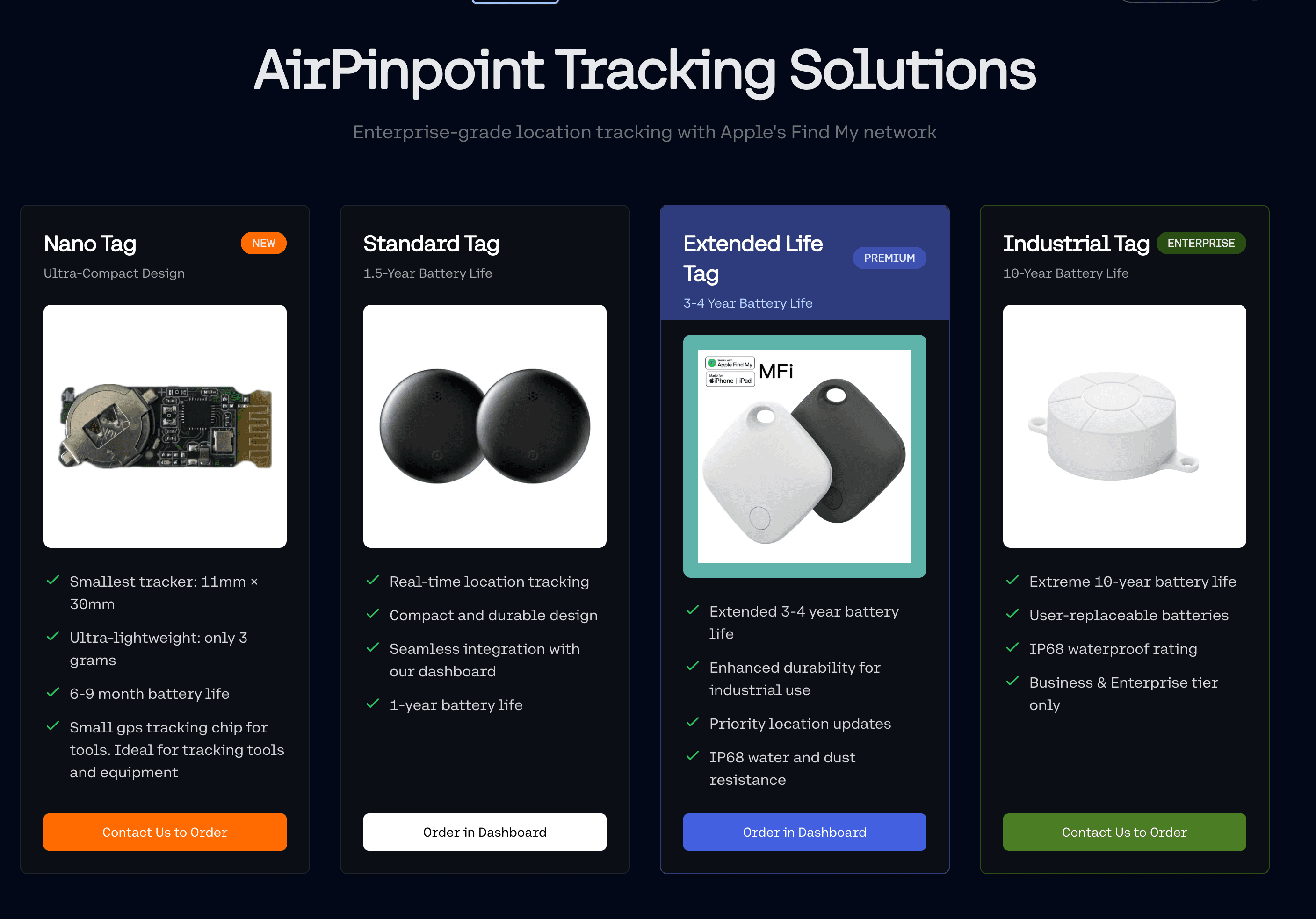
Airpinpoint is that business layer on the Find My side: it puts hundreds of AirTags or Find My tags under one login (Apple caps an Apple Account at 32 items), with location history, polygon geofence alerts, and an API, at $11.99 per device per month. See multi-user AirTag tracking.
Tile's Privacy and Security Record
- June 2024 breach. Life360 confirmed that a hacker used a former employee's credentials to reach an internal Tile tool used for law-enforcement requests, exposing customer names, addresses, emails, phone numbers, and Tile device IDs, then tried to extort the company.
- Anti-Theft Mode (2023). It hides a Tile from the Scan and Secure anti-stalking scan. Owners must verify with a government ID and a biometric scan, and Tile's terms set a $1 million penalty for anyone convicted of using it to stalk.
- Location data sales (2021). The Markup reported that Life360 sold precise location data on its users to data brokers. In January 2022, Life360 said it would stop selling precise location data to most of them.
 Our Solution